Will AI Order Entry Work With My ERP?
The honest answer to whether AI order entry connects to your ERP — what integration really means, which systems it covers, and how to find out for sure.
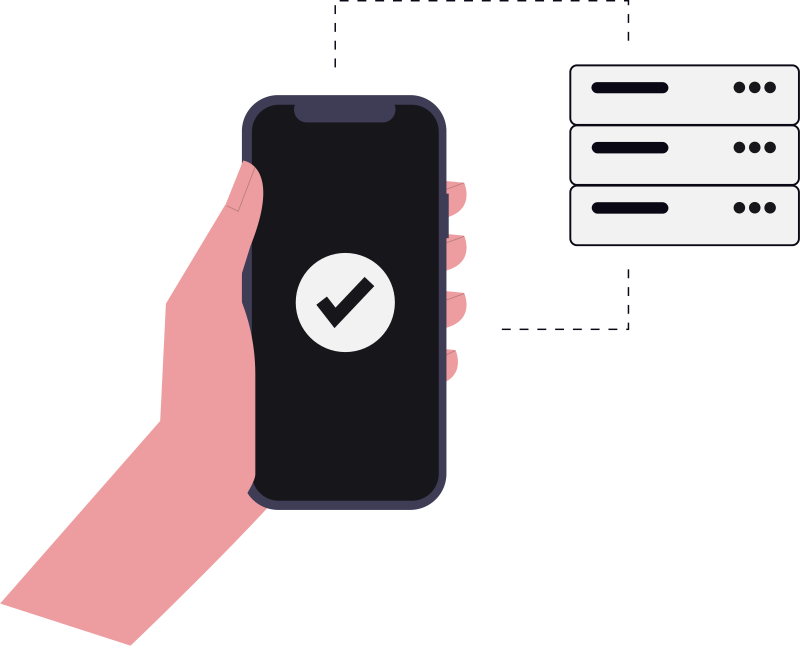
Every evaluation of order automation reaches the same question, usually within the first ten minutes: “Will it work with the system we already run?” It is the right question to lead with. A tool that reads orders beautifully but cannot get them into your ERP has only moved the typing from one screen to another. So before the demo and before the pricing, this is what a distributor actually needs to know.
The short answer, and the honest version
The short answer is: almost certainly yes. AI order entry is built to write into the ERP you already run, and the major distribution ERPs are well-trodden ground. But “integrates with your ERP” is a phrase that does a lot of quiet work, and it is worth pulling apart — because two vendors can both say it and mean very different things.
What you are really asking is not “do you have a logo for my ERP on your website.” It is “can you create a sales order in my system that my system will accept — against the right customer, with the right products, the right price and the right warehouse — without one of my people retyping it.” That is the bar. Everything else is decoration.
What “works with my ERP” actually means
Getting the data out of a customer's email or WhatsApp message is the visible, impressive half. Getting a checked order into your ERP is the half that changes anyone's day, and it is fussier than it looks. Your ERP has opinions. It wants a real customer record, not a name. It wants its own product codes, not the customer's words for them. It wants a price list, a warehouse or plant, sometimes a company or subsidiary. Miss any of those and the order will not post.
So a real integration does four things every time: it resolves the customer to their account, matches each line to your item master, applies that customer's pricing and your rules, and creates the sales order — then hands back the ERP's own order number so you know it landed. If the ERP rejects it, a real integration shows you the reason instead of dropping the order into a silence you find out about in the warehouse.
How it actually connects
“Integration” is not one thing under the hood, and the right method depends on what your ERP exposes. In practice it comes down to a few well-worn routes, and a good vendor uses whichever one your system already supports rather than insisting on its own.
- A modern API — REST or web services — is the cleanest route: the sales order is created directly and the ERP's order number comes straight back. Most cloud ERPs work this way.
- A supported file import — a structured CSV dropped where the ERP watches for it, or collected over SFTP. Common with older or more locked-down systems, and perfectly reliable.
- A secure connection or a small agent for an on-premise ERP behind a firewall, so orders can reach it without opening your network to the world.
None of this is exotic, and none of it is something you have to build. The reason to ask which method a vendor would use is simple: if they cannot tell you, they have not looked at your system yet.
The ERPs this usually covers
If you run one of the systems most food and FMCG distributors run, you are on well-mapped territory. Microsoft Dynamics 365 and Business Central, SAP and SAP Business One, Oracle and NetSuite, Epicor Prophet 21, Odoo, Acumatica, Sage and QuickBooks all speak to the outside world through an API or a supported import — which is exactly what order automation needs.
The name on the box matters less than people expect, though. Two distributors both running “NetSuite” can have completely different item masters, pricing setups and subsidiary structures. So the real question is never “do you support NetSuite” in the abstract — it is mapping to how you have set yours up. That mapping is the setup, and it is the same shape whichever ERP you run.
“But we've customised ours” — or built our own
This is the objection that feels like a dealbreaker and usually is not. Heavily customised sales flows, extra required fields, an unusual approval step — these are configuration, and configuration is what setup maps to. The question is not whether your ERP is standard. Almost nobody's is.
Even a system built in-house is usually fine. The test is simple: can your system accept an order through an API or a file import? If it can, it can be fed automatically — the reading and matching work exactly the same, and only the final write step changes to match your schema. The distributors who genuinely cannot automate are the rare few whose system has no way in at all, and they usually already know it.
What it can see, and what it can't
Connecting anything to your ERP is a fair thing to be careful about — it is where your customers, your pricing and your stock live. So it is worth being precise about what order automation actually needs, because it is less than people fear.
To turn a message into a sales order, it needs to read the data it matches against — your product list, your price lists, your customer records — and it needs to create sales orders. That is close to the whole footprint. It does not need your general ledger, your margins or anything in the ERP that is not about getting an order in. Access runs on credentials you create and can revoke, scoped to what it uses, over an encrypted connection.
And it is worth putting the plain questions to any vendor, us included: what do you store, who can see it, and can we switch it off. A tool that cannot answer those cleanly is telling you something. Every order keeps the original message attached, so there is always a trail back to exactly what the customer sent.
The questions that actually decide it
If you want to know whether a given tool will really work with your ERP, these four questions separate a confident yes from a hopeful one:
- Have you written an order into my exact ERP and version before — and can I speak to whoever did? “We support SAP” and “we have posted sales orders into your S/4HANA setup” are different sentences.
- What happens when my ERP rejects an order? You want “you see the error and the reason,” not a shrug. Silent failures are the expensive kind.
- Who maps my products, pricing and warehouses, and how long does it take? A straight answer here tells you they have done it before.
- Does it write against the right company, subsidiary or plant automatically? If you run more than one, this is where cheap integrations fall over.
We wrote a fuller list of vendor questions here, but those four are the ones that decide the ERP question specifically.
What can genuinely be a problem
In the spirit of not overselling: a few things do make ERP integration harder, and an honest vendor will tell you before you sign, not after.
- An on-premise ERP behind a firewall with no external access. Solvable — usually with a secure connection or an agent — but it is real work, not a checkbox.
- A system with no API and no supported import at all. Rare, but it exists, and no amount of AI opens a door that has no handle.
- A sales process so bespoke that even your own team disagrees on the right steps. The software can follow your rules; it cannot invent the ones you have not settled.
None of these are common, and none are about the AI. They are about the plumbing — which is exactly why you should ask about the plumbing early.
What setting it up actually involves
Setup is mostly mapping, and mapping is mostly a conversation. Someone who knows your ERP sits with someone who knows the tool and agrees how the pieces line up: which field is the customer, how your product codes are structured, which price list applies to whom, how a warehouse or company gets chosen. The more bespoke your setup, the longer that takes — but it is understanding, not building.
Then it is tested on your real orders in a test environment, before a single live order is written, so you watch it create correct sales orders on your own data before you trust it with a Monday. What we will not do is put a fixed “live in two days” on a slide: how long it takes depends on your ERP and how customised it is, and anyone who quotes you a number before seeing your setup is guessing. We would rather spend an extra day getting the mapping right than have you find the mismatch in the warehouse.
How to find out for sure, in an afternoon
You do not have to take anyone's word for this, ours included. The fastest way to know whether a tool works with your ERP is to watch it try. Give the vendor a handful of your real orders and your ERP details, and ask to see a sales order created in a test environment — right customer, right codes, right price. If they can do that on your setup, the marketing question is answered. If they can only show you a polished demo on someone else's system, you have learned something too.
Where ManualOut fits
ManualOut reads the orders your customers already send — email, WhatsApp, PDFs, spreadsheets, voice notes — matches every line to your product list, applies your pricing, minimums and cutoffs, and creates the sales order in the ERP you already run, against the right company and warehouse. Where the ERP is standard, that is straightforward; where it is customised or in-house, we map to it during setup.
And because we would rather show than tell, the honest test above is one we offer directly: send us a few of your real orders and we will run them against your setup, including the awkward ones. If it works with your ERP, you will see it work. If something in your setup makes it hard, you will hear that from us first.
Frequently asked questions
Does AI order entry work with my ERP?
If you run one of the common distribution ERPs — Dynamics 365, Business Central, SAP, SAP Business One, Oracle, NetSuite, Epicor Prophet 21, Odoo, Acumatica, Sage or QuickBooks — then almost certainly, because they all expose an API or a supported import. The real work is not the ERP's name but mapping to how you have configured it, which happens during setup.
What if we have heavily customised our ERP?
That is usually fine. Custom fields, extra required steps and unusual sales flows are configuration, and mapping to your configuration is what setup is for. Almost no distributor runs a truly standard ERP, so this is the normal case rather than the exception.
What if we built our own in-house ERP?
It can still be automated, as long as your system can accept an order through an API or a file import. The reading and matching work identically; only the final write step is mapped to your schema. The rare systems that cannot be fed are the ones with no programmatic way in at all.
Do we have to replace or change our ERP?
No. Order automation sits in front of the ERP you already run and writes into it — it does not replace it, and your team keeps working in the same system. Anyone telling you to switch ERPs to automate order entry is solving the wrong problem.
Does it work if our ERP is on-premise rather than cloud?
Usually yes, but raise it early. An on-premise ERP behind a firewall needs a secure way in — a connection or an agent — which is real setup work rather than a checkbox. Cloud ERPs with an open API are more straightforward.
What happens if the ERP rejects an order?
With a well-built integration you see the rejection and the reason, and the order waits for a person instead of vanishing. That visibility matters more than a headline accuracy figure — a silent failure is the expensive kind, because you find out about it in the warehouse.
How does ManualOut connect to my ERP — API or file?
Whichever your ERP supports. A REST or web-services API is the cleanest route and is how most cloud ERPs work; older or locked-down systems are handled through a supported file import or SFTP, and an on-premise ERP behind a firewall through a secure connection or a small agent. The method adapts to your system rather than the other way round.
What can ManualOut see in my ERP — is my data safe?
It reads only the data it matches against — products, price lists and customers — and creates sales orders. It does not need your general ledger, your margins or anything unrelated to order entry. Access uses credentials you provision and can revoke, over an encrypted connection, and the original message stays attached to every order as an audit trail.
How long does ERP setup take?
It depends on your ERP and how customised it is, because the work is mapping your fields, codes, price lists and warehouses — not building software. A standard cloud ERP is quick; a heavily bespoke or on-premise one takes longer. We would rather get the mapping right and test on your real orders first than promise a fixed number before seeing your setup.